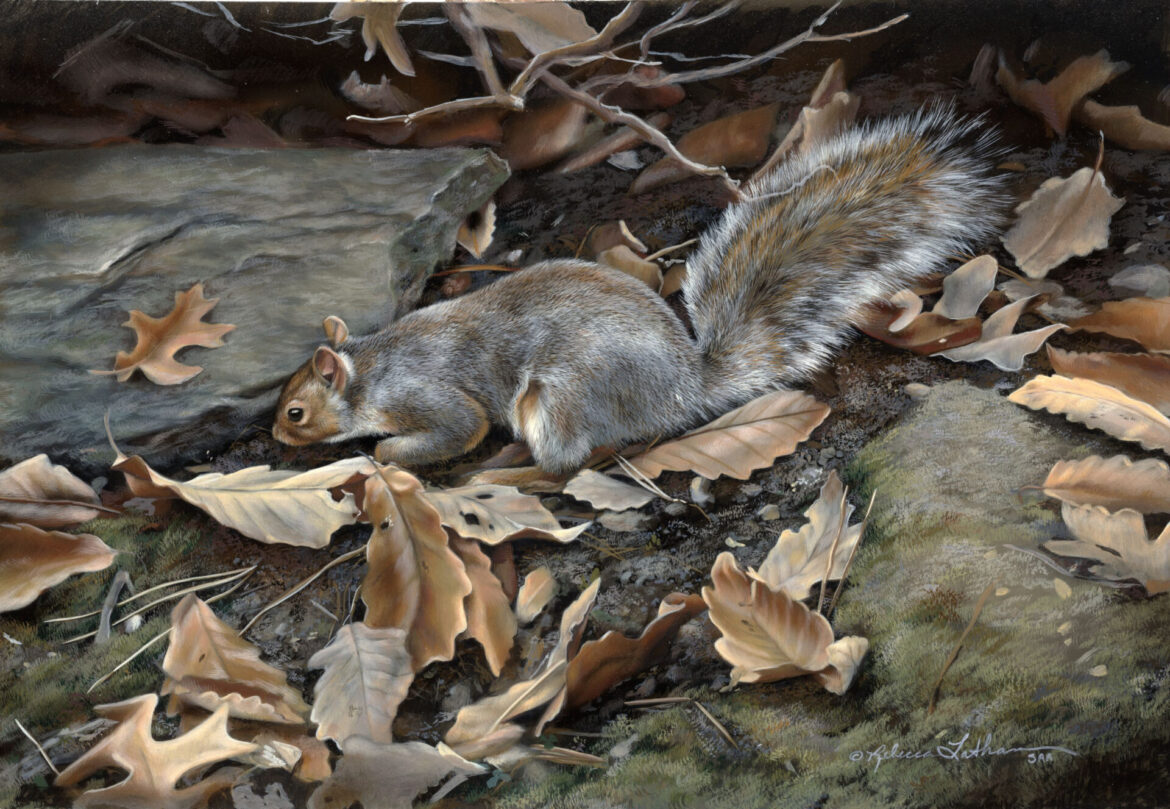
When I’m painting wildlife, realism isn’t just a style—it’s a language of respect. Every brushstroke is an act of observation, of connection, and of storytelling. My goal is not simply to capture an image of an animal, but to share its spirit, its fragility, and its place within our shared environment.
Realism allows me to bridge the gap between art and biology. My upbringing in a family of artists and naturalists made accuracy second nature; I learned early that the subtleties of wildlife—the curve of a whitetail’s ear, the glint in a fox’s eye—carry meaning. To honor these details isn’t just to depict them; it’s to listen to them. I spend hours studying anatomy, behavior, and habitat, so what ends up on the canvas is true to life, not idealized fantasy.
In wildlife art, realism draws viewers into the subject’s world with empathy and wonder. When someone looks closely at a painting of a loon or a wolf and feels they could almost reach out to touch it, that moment of recognition can transform into appreciation—and often stewardship. Art has this gentle power: it reminds us that the natural world isn’t distant, but deeply intertwined with our own lives.
Each painting begins with quiet observation. I often spend time outdoors, sketching or photographing in the early light when animals are most active. Those moments—the hush of morning mist or the rustle of wings over water—become part of the work’s foundation. When I return to the studio, I’m not just relying on references; I’m painting from memory and emotion as much as from precision. That union between fact and feeling is where realism comes alive for me.
Painting realistically, for me, is both a discipline and a dialogue. It asks me to slow down, to look closer, and to convey what I see with integrity. If a painting helps someone see wildlife with new depth or compassion, then the realism has done its work—not as an end in itself, but as a bridge between species, spaces, and hearts.