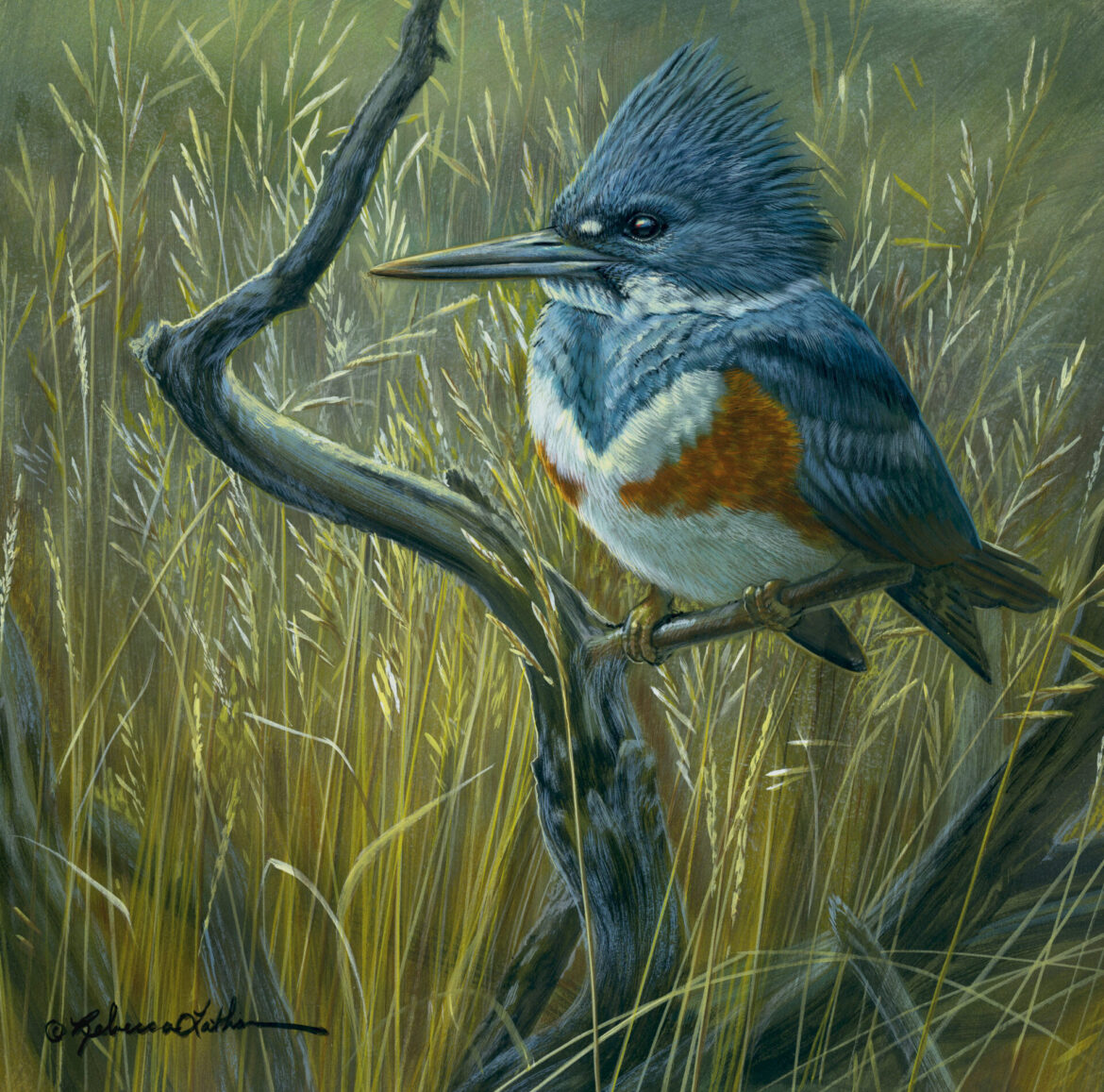
Art has always been a quiet chronicler of the natural world, capturing moments that might otherwise slip away into memory or myth. Long before photographs or field guides, artists sketched the curve of a beak, the span of a wing, the exact shade of a creature’s plumage—creating records that informed science, stirred curiosity, and preserved wonder for generations. In documenting natural history, art serves as both mirror and memory: it holds the precise details of a species or habitat while evoking the living essence that data alone can’t convey.
For me, this role feels deeply personal, woven into every painting I create. My work begins in the field, where I spend hours observing—not just looking, but absorbing the way a fox pauses mid-step, ears swiveled toward an unseen sound, or how sunlight filters through the wet feathers of a loon after a rain. These aren’t casual glances; they’re deliberate studies, notes taken with pencil and camera, meant to anchor the truth of what I’ve witnessed. Back in the studio, those references become the backbone of a miniature painting, where every whisker, feather barb, and muscle tension must ring true.
I see my art as a personal ledger of natural history, one encounter at a time. There was the bald eagle that I watched as it made echoing calls into the distance —details that now live in a small panel on my wall, more vivid than any photograph. The whitetail doe I watched for an entire dawn, her coat shifting from shadow-blue to golden as the light changed. Or the owl I found perched motionless in a rugged elm, its eyes holding a fierce, ancient intelligence; painting it felt like etching that moment into permanence, a safeguard against the fleeting. These pieces and memories aren’t just images—they’re testimonies to behaviors, postures, and atmospheres I’ve been privileged to see firsthand.
Yet there’s a larger purpose, too. As habitats fragment and species face pressures we all know too well, art steps in where words or statistics might falter. A painting can make the abstract urgent: the delicate lattice of a dragonfly’s wing, rendered at actual size, invites you to marvel at its intricacy and mourn its vulnerability. It documents not only what is, but what we risk losing. For artists like me, this is stewardship—using brush and pigment to say, “This existed. I saw it. Here is its quiet, irreplaceable beauty.”
In my studio, surrounded by works in progress, I often reflect on this dual role: art as history keeper for the world, and as my own intimate archive of a life in the wild. Each completed piece adds to both. It’s a humble contribution, but one I make with care—knowing that in capturing the real, we keep alive the chance for others to connect, to learn, and perhaps to protect.