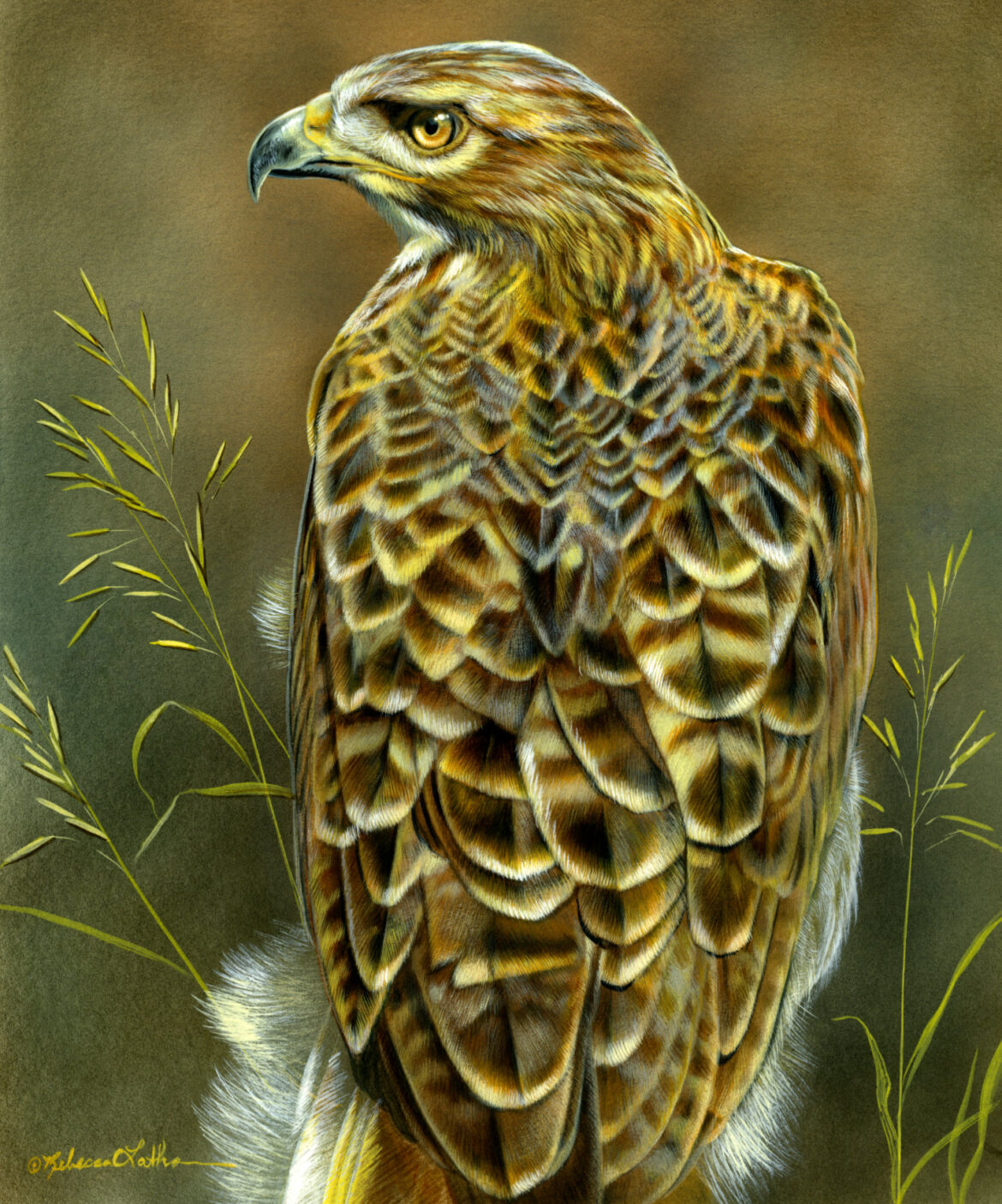
The more time I spend observing wildlife, the more I notice a quiet symmetry binding everything together – repeating patterns, structure, guiding proportions, and rhythms that shape how life unfolds. Nature holds intuition and order at once. To paint it faithfully, I try to listen to that harmony: to understand the geometry beneath beauty without reducing it to design alone.
Geometry is one of nature’s hidden languages. The curve of a feather carries the same sense of balance as a wave’s arc. Shells, horns, petals, and galaxies echo one another through spirals and proportion. These patterns are not rigid rules, but a graceful logic connecting the smallest forms to the vastness around them. Recognizing them helps me paint with greater intuition. When I understand why a curve feels right, I can follow its rhythm without forcing it.
In miniature painting, proportion becomes especially important. Every shadow, texture, and transition must exist in relation to the whole; even a slight shift can change the harmony. Yet precision alone is not enough. Geometry gives a painting structure, but life gives it motion. These principles extend beyond form. They appear in a bird’s flight, grasses moving in wind, and reflections shifting across water. When a composition grows from those natural patterns, the painting begins to feel inevitable – as if it could exist no other way.
I do not think of geometry as calculation alone, but as awareness. Nature’s order is never static; it breathes, shifts, and adapts with light, weather, and life itself. Painting with that understanding feels like collaborating with something timeless. In every curve and balance, I am trying to paint not only what I see, but the quiet harmony that sustains it.